Saturday, September 30, 2006

Monk in Tokyo

( Naar de Nederlandse vertaling.)

You need just two or three notes to learn that Monk is in the house !


For me Thelonious Monk ( 1917 - 1982 ) is one of the greatest jazz artists of the XXth century.

His tunes and compositions, like Round Midnight , Ephistrophy, 52nd Street Theme, Well You Needn't, Blue Monk and Straight No Chaser belong to the standards of jazz. Although many jazz musicians have these tunes on their repertoire they sound at their best when played by the master himself.

His piano playing is the best described as played in a more economical and percussive manner then his fellow piano players and the way he has analysed and developed the phrases of his compositions is great. There seem to be critically "music-admirers" who label Monk's piano style as stride played with a pair of gloves. Funny, but not my opinion.

I played the double CD Monk In Tokyo.

Monk visited Japan in May 1963 for the very first time. It was recorded in the TBS television studios. It certainly was not his best concert, but Monk has always, even in some minor quality concerts, a high standard of music.

Charlie Rouse is sometimes even less inspired at times it seems, but the lenghtly tunes bring, all together, a fine experience
.

Nederlands ( To the English translation )


Je hoeft maar twee noten te horen om te weten dat Monk achter de piano zit.

Voor mij is Thelonious Monk ( 1917 - 1982 ) één van de grootste jazz artiesten van de 20ste eeuw. Zijn composities, zoals Round Midnight , Ephistrophy, 52nd Street Theme, Well You Needn't, Blue Monk en Straight No Chaser behoren tot het basisrepertoire van de jazz.

Hoewel veel jazz musici zich aan zijn composities wagen klinken ze op hun best als de grote meester zelf achter de toetsen zit. Zijn pianospel kan het best omschreven worden als economisch en ritmisch en de manier waarop hij de onderdelen analyseert en uitwerkt is fantastisch. Er zijn ook kritische "muziekliefhebbers", die vinden dat Monk stride piano speelt met handschoenen aan. Grappig, maar zo denk ik er zeker niet over

Ik speelde de dubbel CD Monk In Tokyo.

Monk bracht in 1963 voor de eerste keer een bezoek aan Japan. Dit concert werd opgenomen in de TBS televisie studio. Het was zeker niet zijn beste concert, maar Monk klinkt, zelfs als hij zijn dag niet heeft, van hoge kwaliteit.

Charlie Rouse klinkt soms wat ongeinspireerd, maar de lange uitgewerkte nummers maken het toch waard om de opnamen te beluisteren.

Friday, September 29, 2006

Gafieira

( Naar de Nederlandse vertaling.)

Due to severe problems uploading the blogs, caused by a new update of Blogger, I won't be able to post a blog. I'd love to forward you to one of Jørgen's excellent choro blogs about the dance parties called Gafieira.
Nederlands

Gafieira


( To the English translation )


Tengevolge van ernstige upload-problemen, veroorzaakt door een (foute?) update van Blogger is het maken van een blog niet te doen en dus maar een korte blog vandaag. Graag verwijs ik jullie naar een bijdrage van Jørgen over Gafieira, een benaming voor een choro dansfeest. (Deze blog is helaas niet in het Neder;ands)

Gafieira

Thursday, September 28, 2006

Stan Getz

( Naar de Nederlandse vertaling.)


Thanks to Jazzyjames, who always reads my blogs, I could listen to this great album.

It's a Classics, which contains 12 tunes played by Stan Getz a year before he had to left public life due to drug problems.

He started his career as one of the so called Four Brothers in Woody Herman's Second Herd with Serge Chaloff, Zoot Sims and Herbie Steward.
The Classics series contains numerous discs (this is number 1395) and wants to brings all tunes from celebrated jazz musicians in chronological order. They don't insert alternative takes or radio transcription, but only commercial released recordings. As the copyrights expire after 50 years the series is now working on the 1955 recordings.

Thanks James for sharing these great recordings.

Nederlands ( To the English translation )


Dankzij Jazzyjames, die elke dag trouw mijn blogs leest, kon ik deze fantastische CD beluisteren.

Het is een Classics, die twaalf titels bevat gespeeld door Stan Getz een jaar voordat hij zich tijdelijk uit het publieke leven moest terug trekken wegens problemen met verdovende middelen.
Stan begon zijn carriere als één van de Four Brothers in Woody Herman's Second Herd met Serge Challoff, Zoot Sims en Herbie Steward.

De Classics serie omvat een ontelbaar aantal CDs ( dit is nummer 1395) waarin alle ophamen van gevierde jazzmusici in chronologische volgorde bijeengebracht zijn. Er worden in de serie geen alternatieve takes opgenomen, noch transcripties van radioprogramma's; alleen commercieel uitgebrachte opnamen. Aangezien in Frankrijk de rechten na 50 jaar verlopen is de serie nu bezig met de opnamen uit 1955.

Bedankt James voor deze geweldige plaat !!

Wednesday, September 27, 2006

Betty Boop

( Naar de Nederlandse vertaling.)

The cardboard Hit of the week records were released between 1930 ad the summer of 1932 in the US. In Europe they were sold in bargain shops or as part of a series, like the socalled Veckans SKIVA. Veckans SKIVA means Weekly disc in Swedish. These colourful covers were a kind of magazine with info about the record inside and about showbusiness and film in general. The US covers were less fancy then the Veckans SKIVA


Thanks to Doug Benson, who pointed me on this great cover, I can show you one covering the Hit of the week F-3-4, one of the last ones released in the US.
This one was released too in Scandinavia on 16th of June 1932 as Veckans SKIVA nº 36.

These Hit of the weeks were advertised in the US as TWO BIG "HITS" as they contained two complete tunes on one side of the record.

Each times whe I hear this great tune I wonder if Phil Spitalny used the original arrangements of the signature tune of the cartoon. I've found a Betty Boop cartoon to show you how a Betty Boop cartoon looked like in 1932. It's Betty Boop M.D. from the 2nd September 1932.

Betty Boop M.D. ( Sep 1932)

PHIL SPITALNY'S MUSIC Vocal by BEN ALLEY: Phil Spitalny dir., ? Sam Hermans xyl, Charlie Magnante acc, Ben Alley vo, ETON BOYS vo4: (Jack Day bariton, Earl Smith 1st Tenor, Art Gentry 2nd Tenor, Chas. Day bass)
Recorded New York City, Jun. 1932
1214 C LULLABY OF THE LEAVES (Canción de las Hojas) Young Petkere - BA vo ( HOW F-3-4) ( as vs. nº 36)
BETTY BOOP Fox Trots Heyman Green - EB vo4 ( HOW F-3-4 ) (as vs. nº 36)

source: Hit of the week Discography - Hans Koert (2006)

This blog was also posted at my Hit of the week blog

Nederlands ( To the English translation )


De kartonnen Hit of the week platen werden tussen 1930 en de zomer van 1932 in Amerika uitgebracht. In Europa werden overtollige voorraden gedumpt en kwamen ze in series terecht, zoals de Veckans SKIVA. Veckans SKIVA betekent Wekelijkse Plaat in het Zweeds. De kleurrijke hoes was eigenlijk een soort mini magazine met informatie over de plaat en de showbusiness en film in het algemeen. De Amerikaanse hoezen zagen er heel wat minder uit.

Dankzij Doug Benson, die me op deze hoes wees, kan ik jullie nu een schitterende Veckans SKIVA hoes laten zien, die de plaat HIT OF THE WEEK F-3-4 bevatte, één van de laatste Hit of the week uitgaven. Deze plaat werd ook in Scandinavie op 16 juni 1932 uitgebracht als Veckans SKIVA nummer 36 (v.s. nº 36 )

Deze Hit of the weeks werden in Amerika gepromoot als TWO BIG "HITS" omdat ze twee volledige nummers op één plaatkant bevatten.

Elke keer als ik het nummer Betty Boop hoor, vraag ik me af of Phil Spitalny over de originele filmmuziek arrangementen heeft beschikt. Ik vond een Betty Boop filmpje uit diezelfde periode om jullie een indruk te geven van zo'n cartoon. Het is Betty Boop M.D. geworden uitgebracht 2 september 1932.

Betty Boop M.D. ( Sep 1932)

PHIL SPITALNY'S MUSIC Vocal by BEN ALLEY: Phil Spitalny dir., ? Sam Hermans xyl, Charlie Magnante acc, Ben Alley vo, ETON BOYS vo4: (Jack Day bariton, Earl Smith 1st Tenor, Art Gentry 2nd Tenor, Chas. Day bass)
Recorded New York City, Jun. 1932
1214 C LULLABY OF THE LEAVES (Canción de las Hojas) Young Petkere - BA vo ( HOW F-3-4) ( as vs. nº 36)
BETTY BOOP Fox Trots Heyman Green - EB vo4 ( HOW F-3-4 ) (as vs. nº 36)


bron: Hit of the week Discography - Hans Koert (2006)

Deze blog is ook gepost op mijn Hit of the week blog

Tuesday, September 26, 2006

Horacio Salgan

( Naar de Nederlandse vertaling.)

Horacio Salgan, pianist, leader, composer ( 1916) is one of the great Argentine musicians.

I found a brief biography of him: He was born in Buenos Aires. He initiated his professional work as musician at the age of 14 working in the Universal cinema of Devotee Villa (dumb cinema). He played as a piano player and played popular music, alone and in orchestras. He started his first orchestra in 1944, which lasted up to 1947. With this orchestra he discovered Edmundo Rivero who started with him as a professional singer. His second orchestra acted between 1950 and 1957. In 1980 when being fulfilled his 50 years with music, he participated as a piano player and became director of the Orchestra of the Tango of the City of Buenos Aires. In 1957 he allied musically with the guitarist Ubaldo De Li´o. In 1969 he formed a pair of pianos with Dante Amicarelli. He wrote near four hundred musical compositions. He accounts with a vast musical production, that partly still is unpublished. He received national and international prizes. The Secretariat of Culture of the Nation distinguished him as Emérita Personality of Argentinian Culture.

Enjoy some images Waldo Fonseca from Buenos Aires ( Argentina) sent me to share with you.


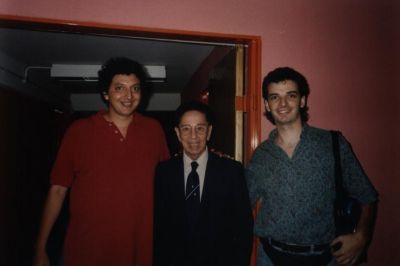
left to right: Horacio Salgan - Carmen Vallejos, Oscar's wife and Oscar Aleman.

Oscar Aleman and Horacio Salgan are both respected musicians. It inspirated Oscar to write a tango dedicated to the great master of tango, horacio Salgan. It is titled “AL GRAN HORACIO SALGAN ” and to be found in a Redondel album.

From left to right: Waldo Fonseca, Horacio Salgan and the bandoneonplayer Alexander Szabo.

Photography taken after one of the presentations of the maestro with the celebrated Real Quinteto.

This blog has also been posted at the Oscar Aleman blog

Nederlands ( To the English translation )

Horacio Salgan, pianist, bandleider en componist ( 1916) is één van de grootste Argentijnse muzikanten.

Ik vond een korte biografie: Hij werd geboren in Buenos Aires. Hij begon als 14 jarige te werken in de Universal studio van Devotee Villa, waar vooral stomme film vertoond werden. Hij speelde er als pianist of als vertolker van populaire muziek, alleen of met orkesten. Hij begon zijn eigen orkest eind jaren veertig. In dit orkest ontdekte hij Edmundo Rivero en dit werd het begin van diens carriere als zanger. Zijn tweede orkest werd gevormd begin jaren vijftig. In 1980, toen hij 50 jaar artiest was, speelde hij piano in het Tango Orkest van de stad Buenos Aires. In 1957 ging hij samenwerken met de gitarist Ubaldo De Li'O. In 1969 trad hij op samen met Dante Amicarelli op twee piano's. Hij schreef bijna 400 nummers, waarvan veel nog ongepubliceerd. Hij ontving nationale en internationale prijzen.

Waldo Fonseca uit Buenos Aires zond me twee foto's die ik op mijn blog heb gezet. Eén waarop Salgan Oscar Aleman ontmoet en één waarin Waldo met El Maestro staat afgebeeld.

van links naar rechts: Horacio Salgan - Carmen Vallejos, Oscar's echtgenote en Oscar Aleman.

Oscar Aleman en Horacio Salgan zijn beiden gerespecteerde musici. Het inspireerde Oscar om een tango te schrijven ter ere van Horacio Salgan, getiteld: “AL GRAN HORACIO SALGAN ”. Deze tango is terug te vinden op een Redondel plaat.

van links naar rechts: Waldo Fonseca, Horacio Salgan en de bandeonspeler Alexander Szabo.

Foto gemaakt na een optreden ter ere van El Maestro, zoals hij eerbiedig genoemd wordt met zijn beroemde Real Quinteto.

Deze blog is ook gepost op de Oscar Aleman blog )

Monday, September 25, 2006

Study in Frustration

The band registrated on 23rd of september 2006 in Middelharnis ( The Netherlands) as the Froggs.

The same band as the Frog Island Jazz Band.

The Froggs definitely are indentified as the Frog Island Jazz Band based in Essex UK. The leader is sousaphone player Rob Fullalove, Banjo is played by Owen Diplock, Drums - Chris Marchant, Piano - Keith Durston, Trombone is played by Ray Joughin, Clarinet & reeds by Sidney ( sorry ... ) Jim Hurd with John Whitehead on cornet completing the line-up. They specialise in the music of King Oliver and Jelly Roll Morton with excursions into the Chicago small band music of the 1920s. It's a A fun bunch of guys who have been together for something like 35 years, says Louis Lince, who put this on the dixieland news list.

Thanks Gerard, Judy, Louis and Robert for your research.

A few weeks ago I found the great box A Study In Frustration - the Fletcher Henderson Story. It contains 4 LPs with the musical legacy of Fletcher Henderson and a treasure of classic jazz. It was for me, as a teenager, a treasure beyond reach, so I bought it right away, although I have this music on other sound recording mediums already ( that's why record collector should be locked up) .

Last night I listened to the first LP with the 1923 and 1924 Henderson recordings ( featuring Hawkins, Redman, Armstrong and Henderson himself) and I remembered the concert of the Frog Island Jazz Band, the night before, I mentioned yesterday in my blog and remembered what I had thought about the survival of this great music. I realised that young guys in 2006, who happens to hear and see this music play, might think that it is music made by and for eldery people and that frustrates me.

The music I hear on the record was made in 1923 by a 19 years old Coleman Hawkins, a 23 years old Don Redman and Louis Armstrong and Fletcher Henderson seems to have been 25 years of age; all the same age as the guys on the next stage who make their music to entertain the audience.

It felt good to see that the music of the Frog Island Jazz Band still inspired some people to dance, although a bit stiffly, but it frustrates me, listening to that great music of Fletcher Henderson, that it won't be able to hear and dance to it, live played within a couple of years.

Maybe that's why my blog and this album both are titled A Study in Frustration !!

For those who missed my previous blog, find it here !

Nederlands ( To the English translation )

The band zoals die optrad op 23 september in Middelharnis als The Froggs.


Dezelfde band als de Frog Island Jazz Band.

The Froggs zijn definitief geidentificeerd als the Frog Island Jazz Band uit Essex (GB). De leider is sousafonist Rob Fullalove, Owen Diplock speelt banjo, Chris Marchant op slagwerk, Keith Durston op piano, Ray Joughin op de trombone, Clarinet Sidney ..... ( sorry ) Jim Hurd en John Whitehead op cornet. Ze hebben zich gespecialiseerd in de muziek van King Oliver en Jelly Roll Morton met uitstapjes naar de Chicago jazz uit de jaren twintig van de vorige eeuw. Het is een vrolijk stel dat al 35 jaar samen speelt, schrijft Louis Lince, die me hierover informeerde via de Dixieland nieuws lijst.

Bedankt Gerard, Judy, Louis en Robert voor jullie naspeurungen.

Een paar weken geleden vond ik de box A Study In Frustration - the Fletcher Henderson Story. Het bevat 4 LP's met de muzikale nalatenschap van Fletcher Henderson - een schatkamer van de klassieke jazz. Als tiener was deze box onbereikbaar voor me, dus kocht ik hem meteen, hoewel ik de muziek al lang op andere geluidsdragers had ( Daarom horen platenverzamelaars ook opgesloten te worden !).

Gisteravond draaide ik de eerste LP met de Fletcher Henderson opnamen uit 1923 en 1924 (met Hawkins, Redman, Armstrong en Henderson) en ik herinnerde me het concert van de Frog Island Jazz Band die avond daarvoor. Gisteren memoreerde ik in mijn blog mijn frustraties over het voortbestaan van deze muziek. Ik realiseerde me dat jonge mensen in 2006, die deze muziek zien en horen spelen, wellicht denken dat het muziek is gemaakt door en voor bejaarden. En dat frustreert me. De muziek, die ik op de LP hoor werd in 1923 gemaakt door een 19 jaar jonge Coleman Hawkins, een 23 jaar oude Don Redman en Louis Armstrong en een Fletcher Henderson met zijn 25 jaar de oudste van het stel; dezelfde leeftijden dus als die van de jongelui op het podium in de zaal ernaast, die daar het publiek aan het dansen krijgen.

Net als 83 jaar geleden.

Gelukkig hadden ook The Froggs genoeg belangstelling en er werd zelfs, zij het een beetje stram en stijf, gedanst, maar het frustreert me, zoals ik gisteren al zei, dat over een paar jaar deze muziek, wellicht, niet meer live te horen zal zijn.

Misschien heten daarom mijn blog en die box wel allebei Study in Frustration.

Wie mijn vorige blog gemist heeft kan hier klikken !

Sunday, September 24, 2006

Jazz On Goeree

( Naar de Nederlandse vertaling.)

Saturday 23rd of September 2006 we visited the Jazz On Goeree festival at De Staver at Middelharnis ( The Netherlands). It was a very friendly festival with popular jazz styles. About 800 people enjoyed the four bands that performed at the different locations.

The opening band was the MoodSwings Trio with Michiel Sonnevijlle as a guest on tenor saxophone. Michiel happens to be our nephew, so it made this concert very special. It was his first time he performed with this group of (former) Tilburg conservatory students and all four played a good concert with compositions of Michel Petrucciani and Bert Joris. It was good to see Michiel playing in this more mainstream jazz style; complete different from the style he used to play at DrZilch.

The star of the evening was Laura Fygi, well known jazz vocalist, who gave a perfect show with songs from the Brazilian and American songbook. A born entertainer. She was accompanied by some very skilled Dutch jazz players like Hans Vroomans at the piano, Marcel Serierse on drums. Jan Menu on tenor sax and Maarten van der Grinten on guitar. The audience enjoyed this show very much wich was well arranged.

In the meantime two other bands performed at some smaller stages, like the Froggs, an English dixieland band, who played to entertain the elder part of the audience. They played tunes from the 1920s of Louis Armstrong's Hot Five and Clarence Williams in a very pure way. No popular gimmicks or jokes, common to this kind of bands, but just the pure traditional black jazz style from the 1920s as dixieland ought to be. It's a pity that no youngster are in that band; all members must have been retired years ago, which means that within a few years this kind of music will have been disappeared from live stages.

The MoodSwings, a jazz collective as they call themselves, entertained the rest of the audience who wanted to dance. They enjoyed the funky rock jazz tunes of the young folks in this collective band. Michiel was also part of this band and we liked to see him playing before this enthusiast audience.

This sympatic Jazz-On-Goeree festival was a benefit for Unicef, which received 15.000 euro for projects in Southern Sudan.

Thanks Michiel for the tickets and the great evening.

Nederlands ( To the English translation )


Op zaterdag 23 september 2006 waren we op het Jazz On Goeree Festival dat werd gehouden in De Staver in Middelharnis.

Het bleek een heel gezellig festival. Ongeveer 800 mensen genoten van de vier bands, voor elk wat wils, die in verschillende zalen optraden.

De opwarmer was voor het MoodSwing trio, uitgebreid met Michiel Sonnevijlle op tenor sax. Aangezien Michiel ons neef(je) is maakte dit concert voor ons wel heel speciaal. Hij speelde voor de eerste keer mee met dit uit (vormalige) Tilburgse conservatorium studenten gevormde trio. Ze speelden composities van Michel Petrucciani en Bert Joris en het was goed Michiel te horen spelen in deze stijl, die zo anders is dan die van DrZilch.

De ster van de avond was Laura Fygi, een bekend jazz zangeres. Ze gaf een perfecte show met standards uit het Braziliaanse- en Amerikaanse songbook. Een geboren entertainer. Ze werd begeleid door een quintet van louter ervaren jazz muzikanten zoals Hans Vroomans op piano, Marcel Serierse op drums, Maarten van der Grinten op gitaar en Jan Menu op tenor. Het publiek genoot van de perfect gearrangeerde show.
Ondertussen speelden twee andere bands in een paar andere zalen. De Froggs, een Engels dixieland band, was ingehuurd om het oudere deel van het publiek te entertainen. Ze speelden muziek uit de jaren twintig van de vorige eeuw in een pure stijl zoals we dat kennen van Louis Armstrong en Clarence Williams, zonder effecten of kolderieke vertoningen zoals nog al eens bij dit soort bands gebruikelijk is.

Jammergenoeg speelden er geen jonge mensen in dit orkest, wat betekent dat over een aantal jaar dit soort muziek wel eens verdwenen kan zijn van de live podia.
The MoodSwings, een jazz collectief zoals ze zichzelf noemen, bestaat uit louter jonge mensen. ze kregen moeiteloos de beentjes van de vloer met hun funky jazz rockachtige ritmen. Het was leuk Michiel hier weer te zien als deel van de groep spelend voor het enthousiaste publiek.

Dit sympathieke Jazz-On-Goeree was een benefiet festival ten bate van Unicef. De opbrengst, € 15.000 komt ten goede aan projecten in Zuid Soedan.

Bedankt Michiel voor de kaarten en de gezellige avond.

Saturday, September 23, 2006

Original Prague Syncopated Orchestra anno 2006

( Naar de Nederlandse vertaling.)

Some weeks ago I told about the great concert of the Original Prague Syncopated Orchestra, I remembered from the Oude Stijl Jazz Festival in Breda May 1978. You can find it in one of my Keep swinging blogs.

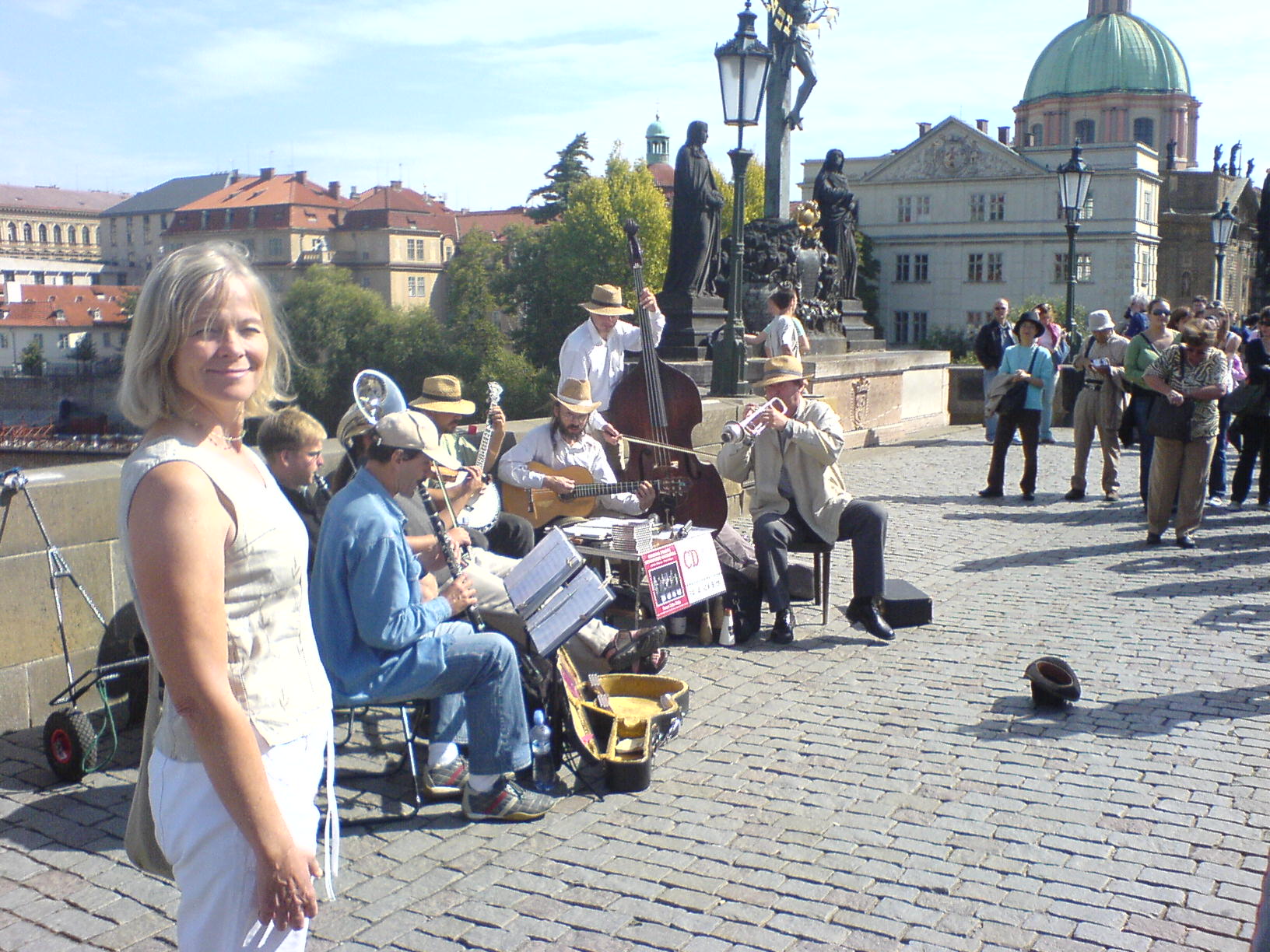
Tom Skovgaard from Denmark responded and told me that he had seen and heard the orchestra last summer in Prague. He sent me a file of a tune to demonstrate their music anno 2006 and a little film he made on his telephone. I'm sure you'll like it.

Sweet Like This by the Original Prague Syncopated Orchestra

The Original Prague Syncopated Orchestra live in the streets of Prague (2006)

Thank you Tom, for sharing this with us. It really is a great band !!


Nederlands ( To the English translation )
Een paar weken geleden vertelde ik over het concert van de Original Prague Syncopated Orchestra in Breda, zoals dat in mei 1978 plaats vond. Je vindt dit in mijn blog van eind augustus 2006.

Tom Skovgaard uit Denemarken reageerde en vertelde me dat hij afgelopen zomer de Original Prague Syncopated Orchestra in Praag had zien spelen op straat. Hij stuurde me een link zodat we kunnen horen hoe ze nu klinken en een filmpje, dat hij met zijn telefoon maakte.

Geniet er van:

Sweet Like This door de Original Prague Syncopated Orchestra

The Original Prague Syncopated Orchestra live in de straten van Praag (2006)

Bedankt Tom, dat je dit met ons hebt willen delen. Het is een geweldig orkest !!

Friday, September 22, 2006

Noble Sissle

( Naar de Nederlandse vertaling.)

Noble Sissle was one of those band leaders that appealed to my imagination, specially in his cooperation with Eubie Blake. One of my favorites, and a well known tune they often performed as a vaudeville duo I'm Just Wild About Harry.

Born in 1889 Sissle made recordings with his orchestra from the early 1920s up to the 1960s. He died in Tampa (Fl)(USA) in 1975.

I found a little biography on film for you about his life: Noble Sissle - A Harlem Renaissance Project

To show you why I like his music I've selected a little film for you. It must be from the Ciro's Club around 1930 and it contains some 1920s tunes like Those Little White Lies and Happy Feet ( including a tap dancer). I couldn't find this item in the Meeker books, so I can't give you the names of the band members.

It brings me the true spirit of the music of the Roaring Twenties.

Noble Sissle Orchestra

Nederlands ( To the English translation )


Noble Sissle was één van die orkestleiders, die vroeger al tot mijn verbeelding spraken, speciaal in zijn samenwerking met Eubie Blake. Eén van mijn favorieten was het bekende vaudeville nummer, I'm Just Wild About Harry, dat hij met Eubie Blake opnam.

Hij werd geboren in 1889 en maakte al platen vanaf de jaren twintig tot de jaren zestig van de vorige eeuw. Hij stierf op 75 jarige leeftijd in Tampa (Florida) (USA).

Ik vond een korte gefilmde biografie, die ik jullie niet wil onthouden: Noble Sissle - A Harlem Renaissance Project

Het korte optreden op film dat ik wil laten zien dateert van rond 1930 denk ik en is een medley van Those Little White Lies en Happy Feet. Ik heb het niet terug kuinnen vinden in de filmography, dus weet ik niet wie de leden van de band zijn. Het demonstreert voor mij het ware geluid van de Roaring Twenties:


Noble Sissle Orchestra

Thursday, September 21, 2006

Eddie Henderson

( Naar de Nederlandse vertaling.)

No, it's not the Skovbærgrød, that makes me a wry face; it's the music that's in the CD player at that moment. The Skovbærgrød was delicious, Hanne and Jo, don't worry, and we consider if we will swap this record for a dozen of these boxes.

Without joking - Eddie Henderson is an excellent trumpet player. I heard him playing last summer at the North Sea Jazz Festival in Rotterdam as a member of the Benny Golson All Star Band, but this 1975 recordings, titled Sunburst, is not my piece of cake. I don't like this kind of rock-orientated jazz common by some musicians in the 1970s.


So, if someone has a suggestion to swap this record, let me know ( Contact me )

Nederlands ( To the English translation )


Nee, het is niet de Skovbærgrød, dat me zo zuur doet kijken, maar de muziek. De Skovbærgrød, een soort van bosvruchtensap, smaakt verrukkelijk, Jo en Hanne, maar we denken er sterk over de CD Sunburst te ruilen tegen een dozijn pakken van dit spul.

Zonder gekheid - Het is niet dat Eddie Henderson
geen trompet kan spelen. Ik hoorde hem op het Northsea Jazzfestival in Rotterdam afgelopen zomer in de All Star groep van Benny Golson. Een groot trompetist, maar deze plaat uit 1975 kan me niet bekoren. Ik hou niet zo van de rock-jazz uit die periode.

Als iemand een voorstel heeft om hem te ruilen hoor ik dat graag (Contact me )


Wednesday, September 20, 2006

Harry Fleming

( Naar de Nederlandse vertaling.)

A composite picture of Harry Fleming's group for the Hansa Theatre in Hamburg.
Harry Fleming or Flemming ( both versions seem to exist) was a well known entertainer of the first half of the XXst century. We learned about him while researching the Oscar Aleman story. It was Harry Fleming, who invited the Les Loups duo (Gaston Bueno Lobo and Oscar Aleman) to join his revue. In 1928 they became a part of Harry Flemings group. In this group Oscar Aleman learned to improvise. Harry Fleming, living in Denmark but travelling all over the world saw the duo playing in one of the popular dance clubs in Buenos Aires. Harry Fleming, born from the Virgin Islands, then part of Denmark, was an entrepreneur, (tap) dancer, adventurer, gigolo and boxer and led a revue with a 15-piece band. Famous musicians that appeared for some time in this band were Tommy Ladnier (tp), Herb Flemming (tb) (not a relative), Roy Butler and Albert Wynn. tb

Another promo picture with Los Lobo in front and the 8 Fleming Girls.

In Feb. 1929 the Los Lobos duo visited with the Harry Fleming group Spain. They played all around Spain (Madrid, Barcelona, Bilbao, Sevilla and Cádiz) until finally settling in Madrid. They also performed with Harry Fleming in other countries like Portugal, Belgium, Switzerland, Greece, Italy, The Netherlands and Germany, but mainly on the Iberian Peninsula and were billed in the revue as the “Hawaiian Guitarists” in white clothes and with flower garlands. Due to a financial argument Lobo and Aleman left the group.
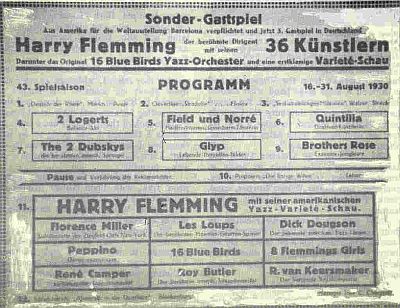
Program for a German performance with his Yazz-Orchester ( sic).
I found an article in Storyville nº 71 (June 1977)( by Peter Darke and Ralph Gulliver) about Roy Butler, who played with Harry Fleming and is on the picture as the man with the saxophone at the right and above in the orchestra second from the right. It is a composite picture of Harry Fleming's Bluebirds and artists ( The eight girls are the 8 Fleming Girls) at the Hansa Theatre in Hamburg (Germany). Another picture shows the same group with again Les Loup in front of the orchestra on a prominent place. Harry Fleming is on the left and Florence Miller, a solo dancer is on the right. Roy Butler is the saxophone player to the right of the sousaphone.

He said: There ( = Paris), I joined Harry Fleming's Revue. He was an American from the Virgin Isles and he formed a large stage band with chorus, plus various name artists to assist. We played the Hansa Theater in Hamburg, the Circo de Precie Teatro in Madrid, to name a few. We went all over Spain, some dates in Holland, Belgium, France and Italy." The Defender, 26 October 1929, lists Harry Fleming's Blue Birds in Spain as Tommy Ladnier, trumpet, Herb Flemming, trombone, Roy Butler, Wilson Townes, saxes, Frank Ethridge, piano, 'Strappy' Jones, drums.

Harry Fleming promo picture on a flyer for a performance at the TeatroArriage in Bilbao ( Spain) ca. 1930

"Off and on I was with Fleming for about three years." Roy said. "Personally, he wasn't a bad fellow, just a bit unwise. He was always overspending money he didn't have. He'd hire a show into a city without having enough to get them there. The personnel of the band changed many times during the years I was with him. So did the artists. There was a British arranger with us, Bobby Wolly. I can't recall ever having made records with him but I don't rule it out because things were so hectic then with Fleming. We never knew if he was going to get enough money to get us to the next theatre or not! He went as far as he could and eventually nobody would hire him any more. He died very pitifully in Paris."

Herb Flemming, not a releative of Harry Fleming, reorganized his International Rhythm Aces to tour in much the same fashion as Harry Fleming had done.Thanks to this article we also found a programme of Harry Fleming's 16 Bluebirds Revue for August 1930.


The bill is made for a performing of Flemings revue in the Teatro de 18 Julio in Montevideo ( Uruguay ) on Thursday the 24th of January. Les Loups is part of the appearance too. It might be possible that some of the artists mentioned on the bill are visible on the publicity picture.

This blog is also posted at the Oscar Aleman blogspot ( http://oscar-aleman.blogspot.com/2006/09/les-loups-harry-fleming.html )

Nederlands ( To the English translation )


Harry Fleming of Flemming ( beide schrijfwijzen kom je tegen) was een bekende entertainer tijdens de eerste helft van de twintigste eeuw.

We hebben onderzoek naar hem vericht i.v.m. het Oscar Aleman project. Harry Fleming nodigde het duo Les Loups ( Gaston Bueno Lobo en Oscar Aleman ) uit om op te treden in zijn revue. Vanaf 1928 waren ze één van de acts. Oscar Aleman leerde er te improviseren. Harry Fleming, die in Denemarken woonde, die over de hele wereld reisde, had het duo zien optreden in één van de populaire dansclubs van Buenos Aires (Argentinie)

Publiciteitsfoto ca. 1930 voor het Hansa Thater in Hamburg
Harry Fleming, geboren op de Maagdeneilanden, toen een deel van Denemarken, was een impressario, tapdanser, avonturier, gigolo en bokser en leidde een revue met een 15 man tellend orkest. In dat orkest zaten musici als Tommy Ladnier, Herb Flemming ( geen familie), Albert Wynn en Roy Butler.

Folder voor een optreden in Duitsland van Harry Flemming and his 16 Blue Girls Yazz-Orchester ( sic)

In februari 1929 bezocht Los Lobos met Harry Flemings groep Spanje. Ze speelden in steden als Madrid, Barcelona, Bilbao, Sevilla en Cadiz totdat ze neerstreken in Madrid. Ze traden ook met de revue op in andere landen van Europa, zoals Portugal, Belgie, Zwitserland, Griekenland, Italie, Nederland en Duitsland, maar meestal bleven ze in Spanje. Ze stonden op de affiches als Hawaiian Guitarists en droegen witte kleding met bloemen slingers. In 1931 stopte de samenwerking vanwege financiële problemen.

Ik vond een artikel in Storyville nº 71 ( Juni 1977) ( geschreven door Peter Darke en Ralph Gulliver) over het leven van Roy Butler, die in Harry Flemings orkest saxofoon speelde. We vinden hem terug op een duidelijk in elkaar geplakte foto als de man met de saxofoon rechts en boven in het orkest tweede van rechts. Het is een compositie foto van Harry Fleming's Bluebirds met alle artiesten, waaronder de 8 Fleming Girls en Les Loups prominent van voren naast Harry Fleming. De foto is gemaakt voor het Hansa Theater in Hamburg.

Deze foto toont ons dezelfde groep met weer Les Loups vooraan, Harry Fleming links en behalve de 8 Fleming Girls ook Florence Miller, die een dansact had. Roy Butler is op de foto rechts van de sousaphonist te vinden.

Roy Butler zegt in het artikel: Daar ( in Parijs) sloten we ons aan bij Harry Fleming's revue. Foto van het orkest voor het TeatroArriaga in Bilbao ( Spanje)

Hij was een Amerikaan, afkomstig van de Maagdeneilanden en had een groot orkest gevormd met zangeressen en verschillende beroemde artiesten. We speelden in het Hansa Theater in Hamburg en het Circo de Precie Teatro in Madrid om er maar een paar te noemen. We traden overal op in Spanje en een paar uitvoeringen in Nederland, Belgie, Frankrijk en Italie. Het blad The Defender van 26 oktober 1929 noemt als artiesten Tommy Ladnier (tp), Herb Flemming (tb), Roy Butler(s), wilson Townes(s), Frank Ethridge (p) and Strappy Jones (dm). Ik speelde drie jaar lang af en toe bij Fleming, zegt Roy. Als persoon was hij geen slechte kerel, alleen een beetje onbehouwen.

Het aanplakbiljet is van een voorstelling in het Tetro de 18 Julio in Montevideo (Uruguay ) op donderdag 24 januari 1929. Les Loups is ook weer van de parij. Het is goed mogelijk dat dezelfde artiesten ook op de publiciteitsfoto's staan.

Hij gaf altijd te veel geld uit. Hij nam optredens aan zonder dat nagedacht over hoe het te realiseren. De musici in zijn band wisselden vaak toen ik erbij zat. Met de artiesten ging het net zo. Er was een Engelse arrangeur, Bobby Wolly. Ik kan me niet herinneren ooit platen met hem gemaakt te hebben, maar ik sluit niet uit dat het wel gebeurd is; vergeet niet het was een hectische tijd met Fleming. We wisten nooit van te voren of hij wel genoeg geld zou hebben om ons naar het volgende optreden te brengen. We maakten er maar het beste van, hetgeen er toe leidde dat niemand hem meer wilde inhuren. Fleming stierf in jammerlijke omstandigheden in Parijs.

Herb Flemming, geen familie, zette het okest als His International Rhythm Aces voort.

Dankzij dit artikel vond ik ook een programma van Harry Fleming´s 16 Bluebirds Revue uit augustus 1930, zoals dat in Duitsland draaide.

Deze blog is ook terug te vinden in de Oscar Aleman Blog ( http://oscar-aleman.blogspot.com/2006/09/les-loups-harry-fleming.html )

Tuesday, September 19, 2006

Bob Brozman


( Naar de Nederlandse vertaling.)

This time I love to share with you a fragment of Bob Brozman playing some Hawaiian stuff.

Enjoy it


Durium

The contribution I about Harry Fleming will be posted soon, due to some internet problems.

Nederlands ( To the English translation )

Bob Brozman with some Hawaiian melodies

Geniet ervan.

De geplande blog over Harry Fleming kon door problemen met de internetverbinding niet geplaatst worden. Het staat nu gepland voor morgen.

Monday, September 18, 2006

Dewey Redman

( Naar de Nederlandse vertaling.)

Dewey Redman, father of Joshua Redman, died aged 75. He was a tenor saxophone player in the post bop and free style jazz. He got into music at a high school marching band. It's remarkable that other members of this same band were Ornette Coleman and Charles Moffett. He started to become a professional player at the age of 30. He worked and made recordings with Ornette Coleman Quartet and later with Charlie Haden's Liberation Music Orchestra, Keith Jarretts Quintet and Ornette Coleman Reunion band Old and New Dreams. With Charlie Haden he was one of the musicians that were playing at the 1971 Newport Festival in Rotterdam.

I have one record recorded by Dewey Redman's Quartet from this time, late 1970s. It's the album 1978 Musics ( There seems to be also a 1990s Musics album of his hand !) and Dewey plays with Fred Simmons (p), Mark Helias (b) and Eddie Moore (dm). He made this recording after finishing an extensive tour through Europe and also visited the Netherlands then. .


DEWEY REDMAN QUARTET: Dewey Redman ts musette vo,Fred Simmons p, Mark Helias b, Eddie Moore dm.
Recorded Berkeley, 17-19 October 1978
1 - Need To Be - Virgin Strike
3 - Alone Again (Naturally)
4 - Unknown Tongue
5 - One Beautiful Day
6 - Daystar Nightlight


Like most free styled musician his music was hard accesible, but Musics consitutes an exception. The music is great and especially the ballad Alone Again (Naturally) is my favorite. Everybody knows the 1972 version of Gilbert O'Sulivan ( or as a musical base for cabaret tunes like 1948 sung by Gerard Cox ( But few people know that Kees van Kooten and Wim de Bie were responsable for the Dutch words of that song).

Dewey Redman played, except the tenor saxophone, also the Musette, a double-reed arabian instrument. It is to be heard in the tune Unknown Tongue. He also experimented with vocalizing ( = speaking and singing) while playing the saxophone.

Nederlands ( To the English translation )


Dewey Redman, vader van Joshua Redman, is overleden, 75 jaar oud. Hij speelde tenor sax in de avantgarde en free jazzstijl. Hij begon met spelen in de band van zijn highschool , waar toevallig ook Ornette Coleman en Charles Moffett in zaten.

Hij begon pas op dertig jarige leeftijd professioneel te spelen in het Ornette Coleman Quartet en later in Charlie Haden's Liberation Music Orchestra, Keith Jarrett's Quartet en Ornette Coleman's reunion band Old and New Dreams. Hij speelde in 1971 met Charley Haden op het Newport Festival in Rotterdam.

Ik heb één plaat van hem, getiteld Musics, die dateert uit 1978. ( Er blijkt ook een Musics album uit 1995 te bestaan, gespeeld door Dewey Redman). Dewey Redman speelt daarin met Fred Simmons (p), Mark Helias (b) en Eddie Moore (dm.) Deze plaat is opgenomen na een uitgebreide Europese tournee, waarbij ze ook Nederland aandeden. Zoals bij avantgarde en free jazz stijl musici gebruikelijk is de muziek vaak moeilijk toegankelijk, maar Musics vormt hierop een uitzondering. Het is een heerlijke plaat; voor mij is de ballad Alone Again (Naturally) een verrassing. wie kent niet dit nummer, voor het eerst gespeeld door Gilbert O'Sullivan in 1972 en later, in de vertaling van Van Kooten en De Bie als 1948, gezonden door Gerard Cox?

Dewey Redman speelt, behalve de tenor, ook op een arabisch blaasinstrument, de Musette, zoals te horen in Unknown Tongue. Ook zijn speciale manier van zingen en praten door de saxofoon laat hij hier horen.

DEWEY REDMAN QUARTET: Dewey Redman ts musette vo,Fred Simmons p, Mark Helias b, Eddie Moore dm.
Recorded Berkeley, 17-19 October 1978
1 - Need To Be - Virgin Strike
3 - Alone Again (Naturally)
4 - Unknown Tongue
5 - One Beautiful Day
6 - Daystar Nightlight

Sunday, September 17, 2006

Jules Deelder

( Naar de Nederlandse vertaling.)


JULES DEELDER - Jazz is my Religion - a film by Gerard Wessel
For most Dutch jazzfans Jules Deelder is a well known figure. He's a poet, a jazz connaisseur and record collector, a promotor of the pure jazz sound ( = swing, bebop and hard bop ) and a cult figure known as the nightmayor of Rotterdam. His poets and stories about jazz are all in Dutch ( with a few exceptions) and deal with musicans like Chet Baker, Charlie Parker, Brew Moore or Eddy Daté. During the last years he performs as a DJ playing records from his own collection and he published some very interesting compilation of jazz music ( Deelder Draait - Deelder Draait Door - Deelder Blijft Draaien )as a counterpart for all those re-mixed 1950s jazzhits by DJs like Maestro did on his Blue Note Trip CD series.

Within' a few weeks a new selection of jazz recordings will be released, titled Deelder Rhythm

This summer a documentary on DVD about his life was released: JULES DEELDER - Jazz is my Religion. a film by Gerard Wessel (subtitled Niets aan de hand)

I was very anxious to see this documentary and although it brought me but few new information it gives a good view of Deelder's passion for jazz and record collecting, his adoration of certain aspects of the war, about drugs and about being a jazz musician. Some friends, like the Dutch poet Remco Campert, Bert Chabot, cabaret performer and writer and saxophone player Hans Dulfer tell in the film about the way they know Jules. At the end of the film he plays with his Trio Me Reet, in which he plays the drums with Ger "Sax" Van Vooren at the sax. It shows Jules as the pure jazz man, with only his snare drums and brushes trying to create the real jazz sound. If a wonder would happen and I should have to make a choice between being a great poet and writer or a great saxophone player ....... I'd choose to be a sax player he daydreams.

The way Jules talks and thinks about jazz is, in general, mine, but

I was startled by his adoration for everything that has to do with the Second World War, the uniforms, the bunkers in the dunes. Probably due to the fact that he was born in the last year of the war this period fascinates him. It is too enlarged in the film I think.

For foreigners, who are not able to read Jules work, this DVD will be of limited interest, as it is in Dutch and no subtitles at all.

I have followed Jules Deelder's career for years, we heard him in theatre, I read his books and listened to his CDs. In one of his first CD's "Deelder Drumt" ( Zililion 2600012) he uses an image of a Hit of the week label ( Sweetheart of my Student Days)(HOW 1117). This fascinates me for years and I hope Jules can explain me why he used that label in this CD.


Nederlands ( To the English translation )

Voor de meeste Nederlandse jazzliefhebbers is Jules Deelder een bekend figuur; hij is dichter, kenner van de jazz geschiedenis en platenverzamelaar, een promotor van het pure jazz geluid ( swing - bebop en hardbop ), bekend als de Nachtburgemeester van Rotterdam. Zijn gedichten en jazz verhalen zijn in het Nederlands ( met een paar uitzonderingen) en gaan over musici zoals Chet Baker, Charlie Parker, Brew Moore of Eddie Daté. De laatste jaren treedt hij op als DJ en draait jazzplaten uit zijn eigen collectie als tegenhanger voor die geremixte bewerkingen van Blue Note platen uit de jaren vijftig door DJ's als Maestro (Blue Note Trip serie). Ook produceert hij eigen schitterende compilaties.( Deelder Draait - Deelder Draait Door - Deelder Blijft Draaien )

Binnenkort verschijnt een nieuwe compilatie CD, getiteld Deelder Rhythm.

Deze zomer werd een documentaire van Gerard Wessels gepresenteerd over zijn leven: JULES DEELDER - Jazz is my Religion. (ondertitel: Niets aan de hand )

Ik was heel nieuwsgierig naar deze documentaire en, hoewel het maar weinig nieuwe informatie toevoegt, geeft het een goed beeld van het fenomeen Deelder; over zijn passie voor jazz en platenverzamelen, zijn verheerlijking van bepaalde aspecten van de Tweede Wereldoorlog, over drugs en over Deelder als jazzmuzikant. Vrienden, zoals de dichter Remco Campert, Bert Chabot, cabaretier en schrijver en saxophonist Hans Dulfer vertellen over Jules.

Op het eind van de film speelt Jules met zijn Trio Me Reet, waar hij het slagwerk speelt samen met Ger "Sax" van Vooren.
Het laat, denk ik, de pure Jules zien, met alleen een snare drum en twee brushes die probeert het echte jazzgeluid te vinden. Stel dat er een wonder zou gebeuren en ik zou mogen kiezen om mijn schrijverskwaliteiten in te leveren voor dat van een een getallenteerd jazzmusicus, dan koos ik voor het laatste, biecht hij op. en dan graag saxofoon.

De manier waarop Jules praat en denkt over Jazz komt in het algemeen overeen met de manier waarop ikzelf tegen jazz aan kijk. Zijn verheerlijking van de Tweede Wereldoorlog wordt wel erg aangedikt in de documentaire ( zijn belangstelling voor bunkers en uniformen) en dat schokt. Het is wellicht verklaarbaar door het feit dat hij geboren werd in één van de laatste oorlogsjaren en als kind die tijd (on)bewust heeft meegemaakt.

Voor mensen, die het Nederlands niet verstaan, is de documentaire slechts van ondergeschikt belang. De film is in het Nederlands zonder ondertiteling.

Ik volg Jules Deelder's carriere al lange tijd en we hebben zijn theatershows bezocht, zijn boeken gelezen, zijn platen gedraaid. In één van zijn eerste CD's, Deelder Drumt (Zillion 2600012 ) heeft hij een foto van een Hit of the week label geplaatst( Sweetheart of my Students Way) Dit boeit me al jaren en ik vraag me af waarom. Misschien dat Jules me dit nog eens kan uitleggen.

Saturday, September 16, 2006

Night in Barcelona

( Naar de Nederlandse vertaling.)

A Night In Barcelona is a tune written by Harold Land and performed by Bobby Hutcherson and his Quintet (featuring Harold Land). It was recorded for Blue Note in the UA Studios in Los Angeles ( USA) 15 th of July, 1970.

It is a typically 1970s tune as it has a strong rock beat with a floating, modal feeling. Hutcherson and Land both play their own melody lines. Harold Land uses the flutes, a typically 1970s instrument-in-jazz which gives the tune a kind of esoteric feeling.

Both instrumentalists have gathered a good rhythm section for this recording which is part of the Blue Note San Francisco LP like Joe Sample, known from the Jazz Crusadorson piano and John Williamson bass and Mickey Rokeron drums.
It is remarkable to learn how modern this 35 years old tunes sounds.

I heard Bobby Hutcherson playing in the McCoy Tyner - Bobby Hutcherson Quartet in The Hague July 2002 and was impressed by his performance.

I play this tunes because my niece Elselien left for Barcelona yesteray for a half year training period. We wish her an inspiring time in Spain !!


Nederlands ( To the English translation )

Het nummer A Night in Barcelona is geschreven door Harold Land en uitgebracht door het Bobby Hutcherson Quintet (featuring Harold Land). Het werd opgenomen voor Blue Note in de UA Studio's in Los Angeles (USA) op 15 juli 1970.

Het is zo'n typisch nummer uit de jaren zeventig geworden met een sterk ritme en een kabbelende melodielijn. Hutcherson en Land spelen allebei hun eigen melodielijn. Harold Land speelt hier fluit, ook zo'n typisch jaren zeventig instrument, dat het geheel een wat zweverig gevoel geeft.

Beide instrumentalisten worden begeleid door een sterke ritmesectie. Joe Sample, de pianist, speelde normaal gesproken bij de Jazz Crusadors en John Williams en Mickey Roker maken het geheel af op bas en drums.

Opvallend hoe modern deze 35 jaar oude opname klinkt.

Ik hoorde Bobby Hutcherson in juli 2002 spelen met het McCoy Tyner - Bobby Hutcherson Quartet in Den Haag. Ik was toen onder de indruk van zijn vibraphone spel.

Ik heb dit nummer uitgekozen omdat gisteren mijn nichtje Elselien naar Barcelona is vertrokken voor een stageperiode van een half jaar. We wensen haar daar een inspirerende ervaring.


Friday, September 15, 2006

Harbour Jazz Club

( Naar de Nederlandse vertaling.)


In my last blog I asked the Dutch visitors to help me to find the venue and date of a concert of Papa Bue's Viking Jazz Band and the Kwintet of Rob Agerbeek.

In my brother's scrap book I had found a ticket of this concert, we must have attended, without the name of the venue and no year at all. The only information was that the concert took place on Thursday 24 th of April.

As I knew it should have been in the 1970s it was easy to find the three possible years. 1975 was the most likely. Then I found out that Papa Bue had been a guest at the third Oude Stijl Jazz Festival in Gorinchem ( The Netherlands) ( also named Gorkum), that always is held in the month of April. I remember I was at that festival once, so .....

My brother suggested that it was in Rotterdam, the Harbour Jazz Club or the Doelen Theatre. Gerard Bielderman from Zwolle ( The Netherlands), well known discographer of traditional jazz bands, sent me the definitive proof : Papa Bue's Band and the Rob Agerbeek Trio played at the Harbour Jazzclub in Rotterdam on April 24, 1975. This concert was a "Sesjun" radio broadcast. I have a part of it on tape, he told me.

Thanks Gerard.

The Harbour Jazz Club, as I remember, was in a low building near the Central Station in Rotterdam, on a place where now huge buildings have been build. It was the home base of the Harbour Jazz Band with Arie Ligthart, the Dutch Swing College Band banjo and guitar player, who came from Rotterdam. The TROS radio program "Sesjun" was often broadcasted from that venue.

The information in my concert log


( To the English translation )Nederlands


Gisteren vroeg ik de Nederlandse bezoekers van mijn Keep swinging blog me te helpen om een entreekaartje te dateren, dat ik in het plakboek van mijn broer had gevonden. Samen moeten we naar dit concert geweest zijn, maar waar en wanneer? De enige informatie over het concert van Papa Bue en Rob Agerbeek is dat het plaats vond op donderdag 24 april. Het moest ergens in de jaren zeventig zijn geweest. Verschillende mensen zonden me de drie mogelijke jaren; 1975 was het meest waarschijnlijk.

Ik ontdekte dat Papa Bue in 1975 één van de gasten was op het derde Oude Stijl Jazzfestival in Gorkum ( = Gorinchem, een plaats in het centrum van Nederland); aangezien dit festival ook altijd in april gehouden wordt en ik er wel eens geweest was, leek dat de beste optie. Het lukte me gisteren wel om contact te krijgen met een organisator van dit festival, maar nog geen definitief antwoord.
Mijn broer suggereerde dat het wel eens in Rotterdam moet kunnen hebben plaatsgevonden, in de Harbour Jazz Club of in de Doelen. Dankzij een berichtje van Gerard Bielderman, bekend discograaf van traditionele jazzbands, kwam het verlossende antwoord. Het bleek inderdaad dat op 24 april 1975 in de Harbour Jazz Club radio opnamen gemaakt waren voor het programma Sesjun, een live jazz programma van de TROS-radio. Ik heb de opnamen gedeeltelijk nog op band staan, vertelde hij me.

De Harbour Jazz Club, herinner ik me, was gehuisvest in een laag gebouw bij het Centraal Station in Rotterdam, op een plek waar nu hoge kantoorgebouwen staan. Het was de thuisbasis voor de Harbour Jazz Band, onder leiding van Arie Ligthart, voormalig banjo en gitaarspeler bij de Dutch Swing College Band. Arie Ligthart was een rasechte Rotterdammer. Het programma Sesjun werd verschillende malen uitgezonden vanuit deze club.

Bedankt Gerard ( en alle anderen) voor je speurwerk.


De informatie op mijn concert pagina


Thursday, September 14, 2006

NHØP

THIS IS MY 200th KEEPSWINGING BLOGSPOT
DIT IS MIJN TWEEHONDERDSTE BLOG.
Voor de Nederlandse en Belgische lezers heb ik nog een informatieve vraag bij de Nederlandse vertaling. Graag een oplossing.
( Naar de Nederlandse vertaling.)


In the 1970s Niels-Henning Ørsted Pedersen was one of my favorites, not only because of his excellent bass playing but also because of his remarkable name. He is one of the few jazz musicans that is recognized on its initials NHØP. In the scrap book I borrowed from my brothers I found a small ticket with an autography of him; NHØP of all people is asked to write his name on a 4 x 2.5 cm piece of paper.

This little voucher proofs that at least my brother visited a concert during the 1970s of this great bass player. As I'm not sure if I also was a that concert ( I only remember it vaguely) I am happy I heard him playing some months before his death at the Northsea Jazzfestival in the Hague summer 2002 with the Johnny Griffin-Roy Hargrove and the Cedar Walton Trio (click on the title bar or this link to get more info about the concert.

For my Dutch friends I have an additional question about a Dutch concert in the Dutch part of this blog.


Nederlands ( To the English translation )

In de jaren zeventig van de vorige eeuw was Niels-Henning Ørsted Pedersen één van mijn favoriete musici, niet alleen omdat hij zo goed bas speelde, maar voor al ook door zijn opvallende naam. Hij is één van de weinige muzikanten die bekend staan onder hun initialen, NHØP.

In het plakboek van mijn broer ontdekte ik een klein entreekaartje met daarop de handtekening van NHØP; laat nou niemand minder dan NHØP gevraagd worden zijn naam op zo'n klein, 4 x 2,5 cm groot, entreekaartje te zetten. Hoe dan ook, het bewijst dat mijn broer in ieder geval een concert van hem bezocht heeft.

Zelf weet ik niet goed meer of ik er ook bij was, al staat me iets vaags bij. Nog eens navragen ! Zeker weet ik dat ik gelukkig in 2002, een paar maanden voor zijn dood, NHØP nog heb zien spelen tijdens het Northsea Jazzfestival in Den Haag met Johnny Griffin-Roy Hargrove en het Cedar Walton trio. Mer info vind je op
deze pagina


Voor de Nederlandse blog lezers heb ik nog een vraag.

Er bevindt zich ook een kaartje in het plakboek met daarop de informatie dat op donderdag 24 april Papa Bue's Viking Jazzband en het Kwintet van Rob Agerbeek ( met spelfout) optraden. Hier was ik wel bij en ik heb zelfs een vermoeden waar.

Kan iemand me vertellen in welk jaar en op welke plaats dit geweest moet zijn?

mail me op koerthchkz at zeelandnet punt nl


Wednesday, September 13, 2006

Svend Asmussen et liv i musik

( Naar de Nederlandse vertaling.)


My Danish friends brough me this summer as a present the DVD Svend Asmussen et liv i musik. I was very suprised by this present as we met Svend Asmussen July 2005 in Denmark at the IAJRC Convention in the Palace Hotel in Copenhagen.
Like the biography of Svend Asmussen,June Nights - Svend Asmussen's Life in Music, this DVD is made exclusively for the Danish market as it is in Danish without any subtitles at all. I wonder why they didn't make a choice to publish it with English subtitles.

The DVD could be devide in two parts: the first part is an interview with Svend ( in Danish) about his life, filled out with musical fragments and a second part in which Svend is to be seen as a musician through his career ( 1938 - 2003 ) as an entertainer and musician.

It is hard to label Svends musical heritage, he is a jazz musician, a comic, an entertainer.

The playing time of the DVD is extensive: The documentary contains an interview of 1 hours and 18 minutes and the music part contains 1 hours and 48 minutes.

I specially liked the last concert as reproduced on the DVD with his own trio, containing the great guitar player Jacob Fischer, Jesper Lundgaard on bass and Aage Tanggaard on drums, his regular accompanists as we heard playing in the Townhall of Copenhagen.

Svend Asmussen was born in Copenhagen in 1916, which means that he is now over 90 years old.


Find a previous blog about our meeting with Svend Asmussen, July 2005, under the title bar

Nederlands ( To the English translation )

Deze zomer kreeg ik van mijn Deense vrienden de DVD Svend Asmussen et liv i music cadeau. Ik was erg vereerd met dit cadeau, vooral omdat we vorig jaar Svend Asmussen op de Conventie van de IAJRC in het Palace hotel in Kopenhagen ontmoet hadden.

Evenals de biografie van Svend Asmussen, June Nights - Svend Asmussen's Life in Music, die vorig jaar verscheen, is deze DVD uitsluitend voor de Deense markt bedoeld, aangezien hij volledig in het Deens is en geen ondertitels kent.
Een gemiste kans, denk ik - waarom niet minimaal ondertitels in het Engels toegevoegd?

De DVD is te verdelen in twee delen: Het eerste deel is een interview met Svend ( in het Deens uiteraard) opgevuld met muziekfragmenten en het tweede deel toont Svend in allerlei muzikale combinaties opgenomen tijdens zijn lange carriere als muzikant ( 1938 - 2003 )

Het is moeilijk om Svend's muzikale loopbaan in één woord te beschrijven: Hij is een jazzmuzikant, een komiek, maar bovenal entertainer.

De DVD speelt uitzonderlijk lang: De documentaire bevat een interview van 1 uur en 18 minuten en het louter muzikale deel is 1 uur en 48 minuten lang.

Voor mezelf is het laatste concert op de DVD een hoogtepunt. Het laat Svend zien samen met zijn vaste begeleiders, Jacob Fischer, een talentvolle gitarist, Jesper Lundgaard op bas en Aage Tanggaard op drums. Ik heb ze horen spelen tijdens de ontvangst in het stadhuis van Kopenhagen.

Svend Asmussen is geboren in 1916 in Kopenhagen en is dus nu ruim 90 jaar oud.

De link onder de titel leidt naar een eerdere bijdrage over onze ontmoeting met Svend Asmussen, juli 2005.

Tuesday, September 12, 2006

Pete Felleman

( Naar de Nederlandse vertaling.)

At a car boot sale near Oss ( a place in the southeast part of the Netherlands ), a the banks of a fen, I found a shoe box of CDs and CDRs which must have been part of a collection of a jazz fan. Some records were CDRs with few information. One of the items was only titled "50 jaar " Pete Felleman 6/6-47 - 6/6 - 97

The CDR contains a radio program dedicated to Pete Felleman, then 76 years old, who celebrated his 50th anniversary as a radio producer. Pete Felleman, born in 1921, started his first radio program for VARA radio on the 6th of June, 1947 and it was the start of a career in radio. He made amusement and jazz programs with titles as Swing & Sweet, USA Cabaret, VARA's Hitparade, De Regenboog, LP Parade, Songs uit 't verleden in de stijl van 't heden, Amerika zingt and Humorrhythmisch. Part of his radio work was at Luxemburg Radio, a very popular radio station, aimed to the Netherlands.

His dark voice, his poetic use of language, his knowledge of jazz music made him a remarkable personality and his programs were an important source for thousands of jazz fans in the Netherlands in the late 20th century.

Pete Felleman died 6 years ago.

Nederlands ( To the English translation )

Bij een achterbakverkoop, letterlijk een verkoop vanuit de kofferbak van een auto, aan de oevers van een ven bij Oss ( Zuidoosten van Nederland) vond ik een schoenendoos met CDs, die klaarblijkelijk toebehoord had aan een jazzverzamelaar. Er zaten ook CDRs in, vaak met weinig informatie. Eén CDR had als titel "50 jaar " Pete Felleman 6/6-47 - 6/6 - 97

De CDR bevatte een radioopname, gewijd aan Pete Felleman, toen 76 jaar oud, die zijn 50 jarig jubileum bij de radio vierde. Pete Felleman, geboren in 1921, begon op 6 juni 1947 bij de VARA radio zijn carriere. Hij maakte amusements- en jazzprogramma's zoals Swing & Sweet, USA Cabaret, VARA's Hitparade, De Regenboog, LP Parade, Songs uit 't verleden in de stijl van 't heden, Amerika zingt en Humorrhythmisch.

Een deel van zijn radiowerk deed hij voor radio Luxemburg, toen een populaire zender gericht op Nederland.

Zijn donkere stem, zijn poetisch taalgebruik, zijn kennis van de jazz maakten hem voor duizenden Nederlandse jazz fans op het eind van de twintigste eeuw een belangrijke bron van informatie geweest.

Pete Felleman overleed zes jaar geleden.

Monday, September 11, 2006

Roy Smeck

Last night I made a start listening to the great box It's Hotter In Hawaii, a compilation of Hawaiian music from the 1920s and 1930s. What a set. It contains music from artists like Frank Ferera, Sol Hoopii and Roy Smeck and numerous unknown artists. Even Oscar Aleman, hidden as one of the members of the duo Les Loups is present in the set.

Jørgen posted a blog some days ago about Sol Hoopii I recommend. Go and see it and one about the set in the Choro blog

I found a great fragment with Roy Smeck playing the slide guitar and the ukulele in the 1926 film His Pastimes to illustrate the kind of music as played on this set It's Hotter In Hawaii.

Roy Smeck in His Pastimes

Nederlands ( To the English translation ) >

Gisteren heb ik mijn tanden gezet in de fantastische box It's Hotter In Hawaii, een verzameling van vroege Hawaiian muziek uit de jaren twintig en dertig van de vorige eeuw. Een geweldige box. Het bevat muziek van artiesten zoals Frank Ferera, Sol Hoopii en Roy Smeck en tientallen voor mij onbekende bandjes. Zelfs Oscar Aleman, verstopt als één van de Les Loups, is er in terug te vinden.

Jørgen plaatste een paar dagen geleden nog een bijdrage gewijd aan Sol Hoopii. Het lezen waard en over deze box in de Choro blog

Roy Smeck is te zien in de film His Pastimes uit 1926, waarin hij o.a. hawaiian gitaar en ukulele speelt. Deze film is hier bijgevoegd om een indruk te geven van de muziek op deze verzameling.

Roy Smeck in His Pastimes

Sunday, September 10, 2006

Veckans skiva

( Naar de Nederlandse vertaling.)

The cardboard Hit of the week record, released in the US between 1930 and 1932 in a weekly edition was also shipped to Europe. In Europe they were sold as Hit of the weeks or as Sefonos or Sefono related labels in France. In Scandinavia they were sold as Veckans SKIVA. Veckans SKIVA means weekly disc.
The weekly series of disc contained US Hit of the weeks, English duriums and at the end of its being Danish tunes as SUPER duriums. There have been released more then 100 items. Veckans SKIVAs contain the original labeled record, but has a Swedish, magazine like cover.

Thanks to Fredrik Tersmeden from Sweden I can show you more details of one of these releases, the Veckans SKIVA nr. 35. As I don't read or write Swedish I copied his information to share with you.

PAGE 1: [to the right of the photo] Stina Karlsson - “All of Sweden’s Bångbro-Stina” returns this week with two new recordings. [at bottom] This issue: New Swedish accordion record! “Lull – lull – lull” [untranslatable nonsense] one-step and a sailor’s waltz “Some time perhaps accidentally” [the latter title a very free translation…]

PAGE 2
[contains a “review” of the record itself by “critic” Fred Ben (certainly a pseudonym), an announcement that Eduard Hladisch has been in London conducting the Durium concert orchestra for some Swedish recordings and an article predicting which will be the most popular tango melodies during the winter of 1932 and spring of 1933]


PAGE 3
[top left] Every Friday new melodies [top middle] Durium – the first self-changing record presents [top right] Have you all issues released? [left and right of the “label hole”: the lyrics of the two songs and beneath them some short notes on present films and other entertainment news] [beneath the “label hole”] The second Swedish accordion record by the virtuosos Albin Fernström and Bångbro-Stina. Herbert Lanners [a pseudonym for Herbert Landgren] is responsible for the vocal refrains. [bottom] Next issue: Lullaby of the leaves / Betty Boop – two foxtrots in the “Exclusive dance records” series


PAGE 4
[top] Hitherto the following melodies have appeared on Veckans Skiva [beneath follows a complete list of issues 1-34; in the right corner the name of the printing company.

Some additional information:

Stina Karlsson (1909-1982; known as “Bångbro-Stina” after Bångbro, the place she came from) was a popular female accordionist, active mainly in the 1930s and 1940s. She made 18 records for various companies, always playing duets with Albin Fernström. Live she usually performed with an accordion quartet.

Eduard Hladisch (1890-1968) was an Austrian-born composer, arranger, conductor and violin-player who from 1924 onwards worked in Sweden. His working fields included recordings, movies, radio, revues and other stage performances and he was much in demand.

Thanks Fredrik for sharing this great cover with us. I posted it at the online Durium (GB) Discography . This online discography is growing slowly.

This contribution is also posted at the
http://hitoftheweek.blogspot.com ( The Hit of the Week blogspot ).

Nederlands ( To the English translation )

De kartonnen Hit of the week platen, die wekelijks werden uitgebracht in de VS tussen 1930 en 1932 verschenen ook in Europa op de markt. In Europa werden ze verkocht als Hit of the weeks, of herlabeled als Sefono ( in Frankrijk). In Scandinavie verschenen ze deels als Veckans SKIVA . Veckans SKIVA betekent Wekelijkse Plaat.
Deze serie Veckans SKIVA's bevatten Amerikaanse Hit of the weeks, Engelse Duriums and op het eind van zijn bestaan Deense SUPER duriums. Er zijn er meer dan 100 verschenen. De Veckans SKIVA's bevatten de originele kartonnen platen, maar de (tijdschriftachtige) hoes was geheel in het Zweeds geschreven met specifieke informatie over de plaat en algemene informatie m.b.t. de amusementsmuziek.

Dankzij Fredrik Tersmeden uit Zweden kan ik één van deze Veckans SKIVA tot in detail beschrijven. Aangezien ik geen Zweeds lees of schrijf laat ik de uitwerking over aan Fredrik.

AFBEELDING 1:[Rechts van de foto] Stina Karlsson - “All of Sweden’s Bångbro-Stina” opnieuw met twee nieuwe opnamen [onder] Deze uitgave: Een nieuwe Zweedse accordeon plaat: “Lull – lull – lull” [titel zonder betekenis] one-step en een zeemanswals: Någon Gång Si Så Där Apropå“

AFBEELDING 2 bevat een recentie van de plaat door Fred Ben ( uiteraard niet zijn echte naam), en aankondiging dat Eduard Hladisch in London geweest is om het Durium Concert orkest te dirigeren voor een paar Zweedse opnamen en een artikel over welke tango het meest populair zal zijn in het komende halfjaar ( winter 1932 - voorjaar 1933)

AFBEELDING 3: [Boven links] elke vrijdag een nieuwe titels [top midden] Durium – the first self-changing record presenteert: [boven rechts] Heb je alle platen verzameld?[links en rechts van het middengat de tekst van de twee liedjes en daaronder een paar aankondigingen van films en nieuws uit de amusementswereld.[Onder het middengat] De tweede Zweedse accordeonplaat gespeeld door de virtuose Albin Fernström en Bångbro-Stina. Herbert Lanners [een pseudoniem voor Herbert Landgren] zingt het refrein. [onder] Volgende week: Lullaby of the leaves / Betty Boop – twee foxtrots uit de “Exclusive dance records” serie


AFBEELDING 4[boven] Tot nu toe zijn de volgende nummers verschenen op Veckans SKIVA: [Dan volgt een complete lijst van alle Veckans SKIVA's nr. 1-34;

Rechts onder de naam van de drukker.

Nog wat aanvullende informatie:

Stina Karlsson (1909-1982) bekend als “Bångbro-Stina” naar de plaats Bångbro, waar ze vandaan kwam) was een populaire accordeoniste, voornamelijk actrief in de jaren dertig en veertig van de vorige eeuw. Ze maakte 18 platen voor verschillende labels, speelde samen met Albin Fernström. Als ze optrad was dat meestal met een accordeon kwartet.

Eduard Hladisch (1890-1968) was een in Oostenrijk geboren componist, arrangeur en violist, die vanaf 1924 in Zweden werkte. Hij was een veel gevraagd artiest en terug te vinden in allerlei opnamen, films, radio programmas en revues.

Bedankt Fredrik voor deze schitterende Veckans skivahoes en de vertaling ervan. Ik heb hem in de online Durium (GB) Discography geplaatst . Deze online discografie groeit langzaam maar zeker.

Deze bijdrage is ook geplaats in mijn
http://hitoftheweek.blogspot.com ( Hit of the week blogspot ).

Nederlands ( To the English translation )


Saturday, September 09, 2006

Sun and fun


( Naar de Nederlandse vertaling.)

This week Jørgen Larsen surprised me with some very interesting blogs about Boogie woogie, Emmett Miller and Sol Hoopii while suffering in the dunes of Schouwen-Duiveland, one of the former islands of Zeeland ( The Netherlands) with 55 young adults. Thanks for that Jo !!

We had a great camp week with a lot of sun and fun.

I found a nice movie on YouTube from a record collector who made a compilation of his 78rpm record collection - I'd love to share it with you.

Enjoy it


Nederlands ( To the English translation )


Afgelopen week verrastte Jørgen Larsen me met een paar interessante blogs over Boogie Woogie, Emmett Miller en Sol Hoopii, terwijl ik met 55 bijna-pupers probeerde te overleven op Schouwen Duiveland, één van de voormalige eilanden in Zeeland ( The Netrherlands). Het is een prima kampweek geworden met veel zon en plezier.

Ik vond een leuk filmpje op YouTube gemaakt door een platenverzamelaar, waarin hij ons zijn platenverzameling laat zien.

Kijken maar ...

Keep swinging.

Hans


Friday, September 08, 2006

Emmett Miller (1900-1962)

Emmett Miller was a minstrel show singer with an extraordinary yodel-like falsetto voice. Born in Macon, Georgia 1902 he started his career early touring widely with various minstrel shows, however, today he is only remembered for his recordings. Miller made several recordings for Okeh Records between 1924 and 1929, his final recording session was for Bluebird Records in 1936.
His records for the Okeh company made between June of 1928 and September of 1929 were labeled Emmett Miller accompanied by his Georgia Crackers and are of Jazz interest. Among the accompanying musicians are the Dorsey Brothers, Eddie Lang and Gene Krupa, and all recordings by the Georgia Crackers add excellent accompaniment to the sessions.
You may listen to a sample of Emmett Miller and his Georgia Crackers by clicking here
Emmett Miller's influence on early country music has been discussed by others. A detailed career profile headlining this aspect may be reached here
Writer Nick Tosches has written extensively about Miller since the 1970s, and his 2001 book "Where Dead Voices Gather" serves as both a biography of Miller and a history of minstrelsy. You may read an excerpt of his book following this link
The minstrel tradition faded drastically in popularity after 1930, but Emmett Miller continued to perform in minstrel shows until the early 1950's. He finally returned to Macon, Georgia where he died in 1962.
Twenty of Emmett Miller's Okeh recordings have been released on a cd in 1996, shown above. Most of this material is also available in full length RealAudio at The Red Hot Jazz web archive, click here to reach the webpage.
Jo

Thursday, September 07, 2006

Sol Hoopii (1902-1953)

Sol Hoopii is deservedly considered a master of the Hawaiian steel guitar and an originator of a playing style also used by numerous of his followers. He was born in 1902 in Honolulu, Hawaii, as the youngest of 21 children. At the age of three he already began playing the ukulele and soon included guitar and Hawaiian steel in his playing. At age seventeen he left his home and stowed away on an ocean liner and ended up in San Fransisco and made his way to Los Angeles, where he formed a trio with Glenwood Leslie (ukulele) and Lani McIntire (guitar) - the trio was named Sol Hoopii's Novelty Trio and was occasionally extended with Andy Iona on saxophone.
The Novelty Trio often mixed blues and jazz with traditional Hawaiian music. The trio's rendition of "Singing The Blues" is modeled after the famous 1927 version recorded by the Frankie Trumbauer Orchestra and has Hoopii's steel guitar imitating Bix Beiderbecke's and Tram's solo work on this recording.


You may listen to Sol Hoopii's Novelty Trio's rendition of "Singing The Blues" in RealAudio by clicking here

The trio also recorded a cover version of New Orleans Rhythm Kings' "Farewell Blues" which is considered one of the more interesting string band recordings of the 1920s. Listen to Sol Hoopii's Novelty Trio's rendition of "Farewell Blues" in RealAudio by clicking here

Around 1935 Sol Hoopii switched his acoustic steel guitar to electric lap steel and developed a special tuning for this instrument which allowed more sophisticated chord and melody work. He continued beeing an expert in applying his blues-influenced treatments to the standard songs of the day, as well as to Hawaiian favorites. This ability brought him to the movies - Sol Hoopii performed in several Hollywood movies such as 'Bird Of Paradise', 'Waikiki Wedding' and 'Song of the Islands'. He also performed in the soundtrack to the Betty Boop cartoon 'Betty's Bamboo Isle' - have a view by clicking here

Sol Hoopii gave up his career in secular music in 1938 and made only few recordings until his death at the age of 51 in 1953.

Recently Hana Ola Records has released a compilation cd of early Sol Hoopii recordings (HOCD A682617) including material recorded 1927-1936 covering Hoopii's acoustic period and featuring his Novelty Trio on most tracks. Learn more about the cd and listen to sound-clips in mp3 format by clicking here

Jo

Wednesday, September 06, 2006

Boogie Woogie

According to The New Grove Dictionary of Jazz boogie woogie is a percussive style of piano blues, favoured, for its volume and momentum, by bar-room, honky-tonk, and rent-party pianists. The term appears to have been applied originally to a dance performed to piano accompaniment, and its widespread use stems from the instructions for performing the dance on the recording "Pine Top's Boogie Woogie" (1928, Vocalion 1245) by Pine Top Smith. The boogie style is characterized by the use of blues chord progressions combined with a forceful, repetitive left-hand bass-figure; many bass patterns exist, but the most familiar are the "doubling" of the simple blues bass and the walking bass in broken octaves.
Click on picture or link to hear "Pinetop's Boogie Woogie" in RealAudio
The first generation of boogie-woogie pianists - blues pianists who prominently featured walking bass and "eight-to-the bar" rhythms - recorded some notable examples, among them Romeo Nelson "Head Rag Hop" (1929, Vocalion 1447), Arthur Montana Taylor "Indiana Avenue Stomp" (1929, Vocalion 1419) and Charles Avery "Dearborn Street Breakdown" (1929, Paramount 12896). However, these were rent-party pianists who were forgotten in the Depression years.
In 1938 a revival of boogie woogie was initiated by John Hammond through his "From Spirituals To Swing" concerts at New York's Carnegie Hall. Hammond sought out pianists Albert Ammons, Meade "Lux" Lewis and Pete Johnson, whom he put together for a performance by three pianos as the Boogie Woogie Trio blowing up a craze for the boogie woogie idiom for some time. From around this time there was made several soundies, filmed short presentations of these former taxi-drivers and bar-room pianists, together, each alone or teaming up with blues-shouter Joe Turner. An example of a soundie by Meade "Lux" Lewis is available by clicking here
Combined with the Swing craze of the late 30'ies and early 40'ies boogie woogie enjoyed a brief vogue and several recordings were made. The connection with swing is exemplified in such recordings as "Boogie Woogie" by Tommy Dorsey and his orchestra (1938, Victor 26054) and Count Basie's "Basie Boogie" (1941, Okeh 6330). Some recordings by lesser known swing orchestras also had the boogie woogie incorporated in their performance, often combined with vocal. An example of this may be viewed on a soundie featuring Johnny Long & His Orchestra performing "The Boogie Man", click here
By the 1950s boogie-woogie had reverted to the blues, becomming a standard element in the performances of every blues pianist. The style's relevance to jazz declined, however, it survived and was the foundation of much of the Chicago, urban blues idiom. Further it has belonged to the roots of rockablilly, early rock'n'roll and Western Swing. Among guitarists, even today, the boogie woogie pattern has been a constantly imitated device applied on numerous recordings since Arthur Smith introduced his "Guitar Boogie" in 1944. An example of a contemporary performance of this popular guitar piece by the boogie monster guitar player, Tommy Emmanuel, may be experienced by clicking here
Jo

Tuesday, September 05, 2006

Oscar Aleman Odeons

( Naar de Nederlandse vertaling.)

The 1950s were a period of great successes for Oscar Aleman. He stopped playing in small groups, like his Quinteto de Swing, but formed larger orchestras. He performed as the major artist in front of his orchestra. He was a popular artist in radio programs and in dance halls.

Carlos Araujo told me some years ago his remembrances about these dance nights. Each dance night started around ten o’clock in the evening and ran until three o’clock at night. Oscar played four times for half hour. Between these acts a jazz and a tango orchestra performed. Most people who attended these evenings wanted to dance, so the music Oscar played was danceable music. However, in the middle of the program he also would play some excellent swing versions like Rose Madreselva (Honeysuckle Rose) or Tea for Two. His tune “Improvisation on Boogie Woogie” was a smash hit during these dance nights. Oscar tried to dance, to play and to sing at the same time, shaking his body and playing his guitar on his back. He also played the guitar, standing, without using a strap. Tapping the rhythm with his foot in a special way. He also pushed his guitar for a second intending that he would throw it into the audience.

One of his first records in this period is Odeon 55240 as Oscar Aleman y su Conjunta de Jazz. He plays Rio Swanee and Cabeza Hinchada. Enjoy the labels. Mind there is a minor difference between the two versions of the labels and I'd love to know which one was first published.

OSCAR ALEMAN y su Conjunto de Jazz ( Odeon 55240) : Mario Felix cl, Carlin Traversa v, Julio Graña v, Raúl Casanova v, Alberto A. Barbera p, Oscar Alemán g vo, Alberto Ramos g, Aldo “Néne” Nicolini b, Arminio Raguza dm
Recorded Buenos Aires, 16 May 1951
18012 - RIO SWANEE ( SWANEE RIVER ) Fox- Trot (Stephen Foster)
( Odeon 55240 )
18013 - CABEZA HINCHADA – Baiao (Hervé Cordovil) - Oscar Aleman vo
(Odeon 55240)

Listen to Cabeza Hinchada

Nederlands ( To the English translation )

De jaren vijftig van de vorige eeuw waren voor Oscar Aleman de jaren van succes. Hij had zijn Quinteto de Swing ingeruild voor een groter orkest. Hij trad op als belangrijkste solist onder begeleiding van zijn orkest. Hij was in die tijd een veel gevraagde artiest voor radio programma's en in danszalen.


Carlos Araujo herinnerde deze dansavonden. Elke avond begon rond de klok van tien en duurde tot drie uur 's nachts. Oscar speelde dan vier keer een half uur. Tussen zijn optredens speelde het orkest jazz en tango. De meeste mense wilden dansen, dus speelde Oscar dansmuziek. Halverwege zijn optreden speelde hij uitstekende swing zoals Honeysuckle Rose of Tea for Two. Zijn nummer Improvisation on Boogie Woogie was een grote hit op zo'n avond. Oscar probeerde dan al spelend te dansen, zijn gitaar bespelend zonder koord om de nek, het ritme tikkend met zijn voet op een manier zoals alleen hij dat kon. Dat eindigde altijd met het zogenaamd in het publiek gooien van zijn gitaar. Het publiek raakte dan door het dolle.

Eén van zijn eerste opnamen uit die periode was met Oscar Aleman y su Conjunto de Jazz (= Jazz Ensemble). Hij speelde Rio Swanee en Cabeza Hinchada. Afgebeeld vind je beide labels. Ontdek de kleine verschillen in de labels - Ik zou graag weten welk label het eerst gepubliceerd werd. ( De andere kant vind je bij de Engelse vertaling )

Geniet van Cabeza Hinchada

This blog is also published at my Oscar Aleman blog: http://oscar-aleman.blogspot.com/2006/09/oscar-aleman-odeons.html

Good luck with your contributions, Jo, this week. I know they will be very interesting !!


Monday, September 04, 2006

Joe Venuti - Live 1969

In 1969 George Wein brings his Newport All Stars to Copenhagen, Denmark.In the band are Ruby Braff cornet, Joe Venuti violin, Barney Kessel guitar, Red Norvo vibraphone, Larry Ridley bass, Don Lamond drums and of course George Wein piano.

One of Joe Venuti's specialties was to loosen the hairs on his bow and play with the hairs over the strings with the bow underneath the violin. Enjoy a filmed video clip from the concert by clicking here

Giuseppe (Joe) Venuti (September 16, 1903 -- August 14, 1978) was a U.S. jazz musician and violinist. Venuti claimed to have been born aboard a ship as his parents emigrated from Italy, though many believe he was simply born in Philadelphia. Considered the father of jazz violin, he pioneered the use of string instruments in jazz along with the guitarist Eddie Lang, a childhood friend of his. Through the 1920s and early 1930s, Venuti produced many recordings. He worked with Benny Goodman, the Dorsey Brothers, Bing Crosby, the Boswell Sisters and most of the other important white jazz and semi-jazz figures of the late 1920s and early 1930s. However, following Lang's early death in 1933, he began to slip off the radar. After a period of relative obscurity in the 1940s and 1950s, he was 'rediscovered' in the late 1960s.

Info quoted from the written notes accompanying the mentioned video.

Jo

Sunday, September 03, 2006

Ed 'Snoozer' Quinn (1906-1952)


The name of Ed 'Snoozer' Quinn does not pop up frequently in the few historical overviews of the development of jazz guitar playing, therefore the general public interested in the subject mostly has been unaware of this legendary guitarist. In general, people interested in the development of the jazz guitar will mention Eddie Lang and Lonnie Johnson as the originators, next they will point out Carl Kress, Dick McDonough, Teddy Bunn, Al Casey and perhaps a couple of lesser known early American guitarplayers excelling in jazz, but only few will mention Snoozer Quinn before stating that 'the real thing' concerning jazz guitar started, when Charlie Christian entered the scene. Of course, with the back against the wall, most people also will mention Django Reinhardt as a non-American genius that paved the way for the post-Christian development of the jazz guitar, at the same time neglecting Django's great contemporary, Oscar Alemán, and at least a dozen others non-American players of the instrument, forgotten masters of a dusky past enlightened in the general American way of understanding things.
Had it not been for the personal efforts of Johnny Wiggs, trumpeter and founder of the New Orleans Jazz Club in 1946, our knowledge of Snoozer Quinn's mastering of the jazz guitar playing would not have been able to document by recordings.
Towards the end of his short life, Snoozer Quinn was hospitalizied after having contracted tuberculosis. During his stay at a New orleans hospital he was recorded by his friend and admirer, Johnny Wiggs. These recordings made on a non-professional equipment are true impromtu sessions by a master of a guitar playing style that both reflects the influence of Lang, Kress and McDonough, but nontheless is a personally developed way of playing that is unparalleled by his contemporaries.
Quinn got his nickname, 'Snoozer', when working as an accompanist to Bing Crosby during the late 1920'ies. Before this job he had been a member of Peck Kelley's Bad Boys for some time, but it was not until he was introduced to Paul Whiteman in 1929 that he would get into the spotlight for a nine month engagement with Whiteman's orchestra. During this period he was introduced to and became friends with the stars of the Whiteman organization: Bix, Tram, Tea and the rest, taking over Eddie Lang's chair and excelling amazing guitar wizardry, unfortunately not documented by recordings of the period, even though Snoozer participated in a few recording sessions by the Whiteman orchestra in 1929 - the sound of his instrument never came through to the microphone. After this short stint with the stars of New York jazz, Snoozer gradually withdraw from the music scene due to poor health, he settled in New Orleans and spent the rest of his life in oblivion until Johnny Wiggs visited and recorded him at a hospital in that city.
Some of Johnny Wiggs' personal recordings of Snoozer Quinn have been issued on a LP in 1969 (Fat Cat Jazz, 104), but to my knowledge they have not been released in the cd format, yet. Luckily, we are able to listen to Johnny Wiggs'recordings of Snoozer Quinn at the great website of the Louisiana Digital Library.
Another website dedicated to Snoozer Quinn also has audio samples from the Johnny Wiggs recordings and may be reached clicking here
Enjoy Snoozer in his rendition of "Out Of Nowhere"
Jo

Saturday, September 02, 2006

Young Dutch Jazz Cats


( Naar de Nederlandse vertaling.)

Ten years ago, 2 September 1996, a great, historical important CD was recorded titled BRAND NEW ! Presenting the Young Dutch Jazz Cats. (Quintessence Records )

The album reads as an encyclopedia of the Dutch jazz generation as now performing on stages in venues all over the country and abroad. The recordings were made on 2 and 3 September 1996 in Monster ( The Netherlands) and the young musicians, some just finished music school, play with their own combo or as part of different groups. As a steady base, Peter and Marius Beets are present as piano and bass player on all tracks.

The Young Cats on the CD are on trumpet Jan van Duikeren - Michel Varekamp, on fluegelhorn: Niels Tausk, on trombone: Ilja Reijngoud, on alto: Marco Kegel - Peter Peuker - Miguel Martinez- Carolyn Breuer, on tenor: Sjoerd Dijkhuizen - Simon Rigter, on guitar: Martijn van Iterson - Jesse van Ruller on percussion: Joost van Schaik - Joost Patocka - Martijn Vink. A great document.

Tomorrow Jørgen Larsen will make a contribution to this blog. I'm anxious to read your contribution Jo !


Nederlands ( To the English translation )


Tien jaar geleden, op 2 en 3 september 1996, werd een historisch belangrijke CD opgenomen, getitield BRAND NEW ! Presenting the Young Dutch Jazz Cats.


Het album lijkt wel een naslagwerk van jonge Nederlandse jazz musici, die nu optreden op binnen- en buitenlandse jazzpodia. De meesten, net van het conservatorium, spelen met hun eigen groep of in wisselende bezettingen. Peter en Marius Beets zijn op alle opnamen te horen op piano en bass.

De Young Cats op de CD zijn op trompet Jan van Duikeren - Michel Varekamp, op bugel: Niels Tausk, op trombone: Ilja Reijngoud, op altsax: Marco Kegel - Peter Peuker - Miguel Martinez- Carolyn Breuer, op tenorsax: Sjoerd Dijkhuizen - Simon Rigter, op gitaar: Martijn van Iterson - Jesse van Ruller op slagwerk: Joost van Schaik - Joost Patocka - Martijn Vink.
Een waardevol document.

Morgen zal Jørgen Larsen deze web log verzorgen. Er zal dan geen Nederlandse vertaling zijn.

Friday, September 01, 2006

Jacob do Bandolim


( Naar de Nederlandse vertaling.)


This time my choice of the month is a choro CD again. and the second one of Jacob do Bandolim, since I started this blog. I found this CD in July when Jørgen, Hanne and the kids visited Zeeland. The Drukkery in Middelburg ( The Netherlands),a book shop annex record shop has a great collection of jazz and world music records, but I never found a choro CD there before. I used this CD as a subject of a Keep Swinging blog . I'd love to recommend you this CD, that contains music from the 1947 - 1953 period, the period Jacob do Bandolim started to record and the period in which he became famous with his radio programs.

JACOB DO BANDOLIM
1. - Simplicidade
2 - Bole-bole
3 - Pé de Moleque
4 - Forró de Gala
5 - Doce de Coco
6 - Rapaziada do Braz
7 - Despertar da Montanha
8 - Migalhas de Amor
9 - Faceira
10 - Confidencias
11 - Tenebroso
12 - Flamengo
13 - Lingua de Preto
14 - Grauna
15 - Cristal
16 - Elza
17 - Saudade
18 - Treme- treme
19 - Remeleixo
20 - Cabuloso
21 - Gostosinho
22 - Nene
23 - Atlantico
24 - Odeon

Nederlands ( To the English translation )


Deze keer is mijn keus van de maand een choro CD en voor de tweede keer is dat er één van Jacob do Bandolim, sinds ik deze blog startte. Ik vond deze CD in juli 2006, toen Jørgen en Hanne en de kinderen Zeeland bezochten. In de Drukkery in Middelburg ( Nederland), een boekwinkel annex platenzaak, met een ruime sortering jazz en wereldmuziek vond ik voor het eerst deze Choro CD. Ik heb het onderwerp gebruikt in een
Keep Swinging blog . IK kan deze plaat bij iedereen aanraden; het bevat de muziek uit de periode 1947 - 1953, toen Jacob met opnemen begon en hij bekend werd door zijn radio-programma's.


JACOB DO BANDOLIM
1. - Simplicidade
2 - Bole-bole
3 - Pé de Moleque
4 - Forró de Gala
5 - Doce de Coco
6 - Rapaziada do Braz
7 - Despertar da Montanha
8 - Migalhas de Amor
9 - Faceira
10 - Confidencias
11 - Tenebroso
12 - Flamengo
13 - Lingua de Preto
14 - Grauna
15 - Cristal
16 - Elza
17 - Saudade
18 - Treme- treme
19 - Remeleixo
20 - Cabuloso
21 - Gostosinho
22 - Nene
23 - Atlantico
24 - Odeon